


.svg)
Moving parents into assisted living is rarely just a change of address. For many families, it marks the moment when safety, independence, caregiving, finances, and long-held family roles all collide in one emotionally charged decision.
The practical work matters, but the emotional work is just as real. A parent may grieve the loss of a longtime home. Adult children may feel guilt, relief, exhaustion, and uncertainty at the same time. Siblings may disagree about timing, money, or who should handle the move.
As a family owned moving company based in Alexandria, Division 1 Moving and Storage helps Northern Virginia families manage the physical side of local transitions like this, so the family can stay focused on care, communication, and a calmer move.
Moving Parents Into Assisted Living Works Best When Emotion and Logistics Are Planned Together
The most successful moves treat emotional needs and practical tasks as connected parts of the same plan. When logistics are rushed or unclear, emotions often intensify. When emotions are ignored, practical decisions can stall, spark conflict, or feel like a betrayal.
A parent’s fear of assisted living may sound like resistance to packing, furniture choices, or paperwork. Often, it is really fear of losing privacy, daily control, familiar routines, and a sense of identity. Adult children may respond by pushing harder, which can make the parent feel over-managed.
A better approach is to translate emotional needs into practical choices. If a parent fears losing independence, involve them in decisions about the community, furniture, room setup, and daily routines. If they fear being forgotten, create a written visitation and call schedule before the move.
This framing also helps adult children. Guilt is common, but it does not mean the decision is wrong. The move can be understood as a responsible step toward safer care, better support, and less strain on family caregivers.
The Right Time to Move Is Usually Before a Crisis Forces the Decision
Families often wait until a fall, hospitalization, caregiver breakdown, or sudden health change forces a compressed timeline. That kind of urgent move leaves little room for thoughtful tours, careful downsizing, financial planning, or emotional adjustment.
Earlier planning gives the parent more voice. They can compare communities, describe what matters to them, and imagine the new space before decisions feel final. That sense of ownership can reduce the feeling of being “placed” somewhere by others.
Warning signs that a move may need to be discussed include difficulty with daily activities, safety issues at home, increasing health needs, social isolation, and caregiver burnout. None of these signs automatically answers every question, but they do signal that the family should stop treating the current arrangement as indefinite.
Use a decision framework instead of reacting to guilt
Families make clearer decisions when they align three areas: clinical need, financial capacity, and quality-of-life goals. This shifts the conversation away from which community looks nicest and toward which setting can support the next several years of safety, dignity, and connection.
Clinical need includes current function, chronic conditions, cognitive changes, medication needs, mobility, and whether needs are likely to increase. For progressive conditions such as dementia or Parkinson’s, families should ask whether the community can support higher levels of care over time.
Financial capacity requires more than checking the monthly rate. Families should compare current home costs, utilities, maintenance, food, transportation, paid caregiving, and family caregiver time against projected assisted living fees and likely increases.
Quality of life includes independence, social connection, meaningful routines, proximity to family, and the parent’s sense of belonging. Safety is non-negotiable, but quality of life is the value that makes the disruption worthwhile.
Choosing an Assisted Living Community Should Start With Care, Safety, and Fit
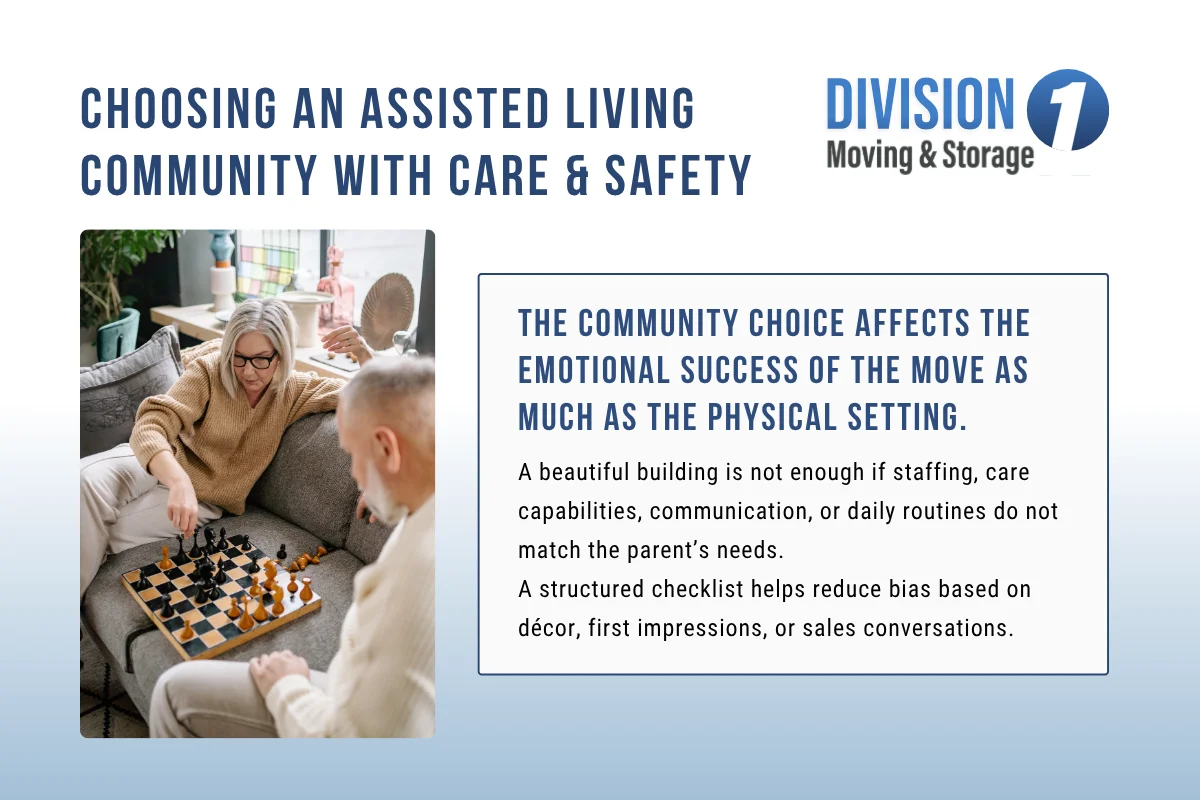
The community choice affects the emotional success of the move as much as the physical setting. A beautiful building is not enough if staffing, care capabilities, communication, or daily routines do not match the parent’s needs.
Families should visit multiple communities in person, ideally more than once and at different times of day. A structured checklist helps reduce bias based on décor, first impressions, or sales conversations.
Clinical and safety questions should come first
Ask what the community is licensed and staffed to provide. That may include help with bathing, dressing, toileting, mobility, medication management, oxygen, diabetic care, catheter care, or dementia support.
Families should also ask what happens if needs increase. Some communities can bring in home health or hospice support. Others may require a transfer if a resident needs complex wound care, two-person transfers, or a higher level of supervision.
Staffing deserves direct attention. Ask about caregiver-to-resident ratios by shift, including nights, weekends, and holidays. Ask whether licensed nurses are on-site, whether clinicians are available around the clock, and how emergencies are handled.
Physical safety matters too. Look for grab bars, non-slip flooring, good lighting, secure handrails, wide hallways, and emergency call systems in bedrooms and bathrooms. For memory care, assess controlled exits, secure perimeters, calm layouts, and spaces designed to reduce wandering or agitation.
Daily autonomy can ease fear about losing independence
Fear of losing independence is one of the strongest emotional barriers to assisted living. Families can address it by asking practical questions about daily life.
How flexible are wake times, meal times, bathing schedules, and activities? Can residents bring their own furniture, photos, bedding, artwork, and familiar items? Does the community support personal routines, or does it expect everyone to follow the same schedule?
These details matter because they affect identity. A parent who can choose their recliner, arrange their photos, and keep a familiar morning routine may feel less like they have lost control and more like they are adapting to a safer version of home.
Social connection should be evaluated, not assumed
Many older adults fear they will be lonely after the move. In some cases, they are already isolated at home, but the new environment still feels intimidating because it is unfamiliar.
Review the activity calendar for variety and relevance. Look for physical, creative, cognitive, spiritual, and social options. Ask how staff help introverted residents or residents with mobility limitations form connections.
Observe how staff interact with residents. Do they know names, histories, and preferences? Do conversations feel respectful and personal, or rushed and task-oriented? A community’s culture often shows up in small interactions before it appears in official materials.

Downsizing Should Protect Memories While Keeping the Move Realistic
Downsizing is often the most emotional part of moving parents into assisted living. Families are not just sorting furniture and boxes. They are handling a lifetime of routines, achievements, relationships, and memories.
The best place to begin is the new space, not the old house. Ask the assisted living community for exact floor plans and room dimensions. Measure the bed, recliner, dresser, small table, television stand, and other priority items.
Create a simple layout that includes walking paths, lighting, seating, and room for mobility aids such as a walker or wheelchair. Once that plan exists, decisions become less abstract. If an item has no safe place in the new apartment, it must be donated, sold, stored, given to family, or discarded.
Use categories that reduce conflict
Sorting goes better when everyone uses the same decision rules. A written system prevents every item from becoming a fresh debate.
Keep: Items that are essential, frequently used, deeply meaningful, and able to fit safely in the new space.
Donate: Useful items in good condition, especially when giving them away feels meaningful to the parent.
Sell: Selected valuables that may help offset move or care costs.
Discard: Broken, unsafe, outdated, duplicated, or expired items.
Undecided: A temporary category for items that are too emotional or contested to decide on immediately.
The undecided category is especially useful. It lowers pressure in the moment and gives the family time to revisit hard choices once the space limits are clearer.
Sentimental items deserve their own process
Photos, letters, heirlooms, awards, and grandchildren’s gifts should not be mixed into general sorting piles. Create a safe zone or clearly marked container for irreplaceable items so they never end up in donation or discard boxes by mistake.
Choose a curated group of meaningful objects for the assisted living room. A small number of familiar items, placed intentionally, can make the room feel like home faster than boxes of unorganized keepsakes.
For items that cannot fit, decide where they will go before move day. Options may include a family member’s home, a small storage unit, or a specific bequest to a relative. Pre-deciding prevents last-minute panic and protects relationships.
A Written Move Plan Keeps Families From Carrying Everything in Their Heads
A move notebook, whether paper or digital, can reduce confusion and repeated conversations. It gives the family one place to track decisions, contacts, dates, and responsibilities.
The notebook should include the floor plan, furniture list, move calendar, master task list, community move-in rules, mover information, and important contacts. It should also track medications, documents, valuables, and items that must travel with the parent rather than on the truck.
This tool is not just organizational. It lowers caregiver stress. Family members often feel overwhelmed because they are trying to remember every decision, deadline, and concern while also managing their own emotions and supporting the parent.
Documents and medications should be handled as move-day priorities
Important documents can become a major bottleneck if they are scattered. Families should gather medical records, prescriptions, physician contacts, health care directives, insurance policies, financial information, wills, and powers of attorney before the move.
Medications should never be buried in packed boxes. They should remain accessible, clearly labeled, and transported in a controlled way. The same applies to identification, insurance cards, glasses, hearing aids, mobility aids, phone chargers, and anything the parent will need immediately.
Move day already involves elevator access, key handoff, room setup, transportation, and coordination with staff. Keeping critical items separate prevents small errors from becoming stressful emergencies.
Choosing the Right Moving Services for Senior Relocations Can Reduce Family Strain
The physical move is one area where families can reduce stress by being realistic about capacity. Adult children may want to handle everything themselves, but caregiving, decision-making, downsizing, and emotional support are already demanding.
Professional moving services can shift the family’s role. Instead of lifting furniture, managing truck logistics, and solving every physical problem, relatives can focus on reassurance, companionship, and advocacy.
For families planning a nearby transition, professional local moving services in Northern VA can be especially helpful when the move requires careful timing with an assisted living community, building access, elevators, and room setup.
Senior move managers and specialized support can coordinate the bigger transition
Senior move managers often provide planning, downsizing guidance, floor plans, sorting support, and coordination with movers and assisted living communities. Their role is broader than transporting items from one place to another.
They may help determine what will fit, arrange donation or disposal of remaining belongings, coordinate storage, and create a homelike setup in the new apartment. This can be valuable when siblings live far apart or when one family member has been carrying most of the work.
A neutral professional can also reduce decision fatigue. Families sometimes argue about what should be kept because the discussion is emotional, not spatial. A floor plan, inventory, and experienced outside guidance can turn a tense debate into a practical choice.
The right mover should understand timing, access, and room readiness
Assisted living moves often require more precision than a standard household move. The community may have specific move-in windows, parking rules, elevator procedures, and requirements for protecting hallways or common areas.
Room readiness matters. A parent’s first impression of the new space can shape the emotional adjustment. Whenever possible, familiar furniture, photos, bedding, lighting, and comfort items should be set up before or immediately after arrival.
Families should choose moving support that can work with a detailed plan, protect belongings, communicate clearly, and keep the day orderly. The goal is not only to move items safely, but to prevent the move from feeling chaotic or disorienting.
Move Day Should Be Designed Around the Parent’s Experience, Not Just the Truck
Move day can be overwhelming for an older adult. Boxes, strangers, noise, decisions, and visible dismantling of a longtime home can intensify sadness or anxiety.
Families can reduce stress by assigning clear roles. One person can be responsible for staying with the parent. Another can coordinate with movers. Someone else can communicate with the assisted living community or manage final checks at the old home.
The parent should not have to answer every question while movers are working. Many decisions should already be made through the floor plan, labeled boxes, and the move notebook.
Separate relationship time from task time
During the move, families often become task-focused. Every visit becomes about sorting, signing, packing, or problem-solving. That can make the parent feel like the relationship has become purely logistical.
Deliberately schedule time that is only for companionship. Share a meal, look through photos, take a short walk, or sit together in the new room without discussing boxes. These moments help preserve closeness during a transition that changes family roles.
Adult children are moving from hands-on caregivers into coordinators, advocates, and visitors. That shift can feel strange, but it can also restore parts of the relationship that were crowded out by daily caregiving strain.
The First Month Is an Adaptation Phase, Not a Final Verdict
The emotional work continues after move-in. Loneliness, disorientation, worry, and fluctuating moods are common. A difficult first week does not automatically mean the move was wrong.
Families should plan the first month as an adjustment period. Regular calls, visits, shared meals, and communication with staff can provide reassurance without preventing the parent from building independence in the new community.
It helps to introduce the parent to staff, neighbors, and activities that match prior interests. If they enjoyed music, faith communities, gardening, cards, exercise, or volunteering, ask the community how those interests can continue.
A written contact plan can calm fears of being forgotten
Parents may worry that moving means family will visit less or become less involved. A clear schedule can make support visible.
The plan does not need to be overwhelming. It might include weekly calls, certain family meal days, rotating sibling visits, and one designated family contact for staff updates. The key is consistency.
Adult children should also clarify their own roles after the move. Who handles finances? Who speaks with staff? Who tracks medical issues? Who updates relatives? Written agreements reduce resentment and prevent one person from silently becoming responsible for everything.

Troubleshooting Common Problems During the Assisted Living Move
Even a well-planned move can hit emotional and logistical snags. The goal is not to eliminate every hard moment. It is to respond in a way that keeps the transition moving while protecting dignity and family relationships.
When a parent says, “I’m not ready”
“I’m not ready” often means more than the words suggest. It may reflect fear of aging, losing control, becoming a burden, or being unheard.
Respond first with validation. Acknowledge that the move is hard and that leaving home is a real loss. Then return to specific concerns: what feels most frightening, what choices still matter, and what would make the new space feel more acceptable?
Multiple conversations usually work better than one ultimatum. Involving the parent in tours, room setup, and decisions about belongings can reduce resistance because it restores some control.
When siblings disagree about timing, money, or responsibilities
Old family patterns often reappear during this process. One sibling may do most of the work. Another may question decisions from a distance. Disagreements about cost, timing, and care can become personal quickly.
Structured family meetings help. Use the same decision framework each time: care needs, safety, finances, quality of life, and the parent’s preferences. Document who is responsible for specific tasks.
If conflict remains high, a neutral third party such as a social worker, elder law professional, geriatric care manager, or transition specialist can help the family move from blame to decisions.
When the new room feels unfamiliar or upsetting
A bare or poorly arranged room can make assisted living feel more institutional. Familiar setup is not a decorative extra. It supports orientation, comfort, and continuity.
Prioritize the bed, favorite chair, family photos, familiar bedding, good lighting, a clock, a phone, and meaningful objects. Arrange the room to resemble home where possible while keeping safe walking paths.
If the parent becomes upset on arrival, slow the pace. Let them sit, orient, and see familiar items. A family member’s calm presence can help the space feel less foreign.
When caregiver guilt spikes after move-in
Adult children may feel guilty even when the move improves safety and care. Guilt can intensify when a parent is sad, angry, or asking to go home.
Name the feeling without letting it control every decision. The move should be judged by care needs, safety, quality of life, and realistic family capacity, not by one painful conversation.
Caregiver self-care matters during this stage. Rest, exercise, support groups, counseling, and social time are not selfish. Better-supported family members make clearer decisions and can show up with more patience.
A Calmer Move Gives Families More Room to Be Family
Moving a parent into assisted living asks families to manage safety, grief, money, possessions, and changing roles all at once. A structured plan creates breathing room. The parent gets more choice where choice is possible. Adult children get relief from trying to carry every detail alone.
When the physical move is handled well, the family has more energy for what matters most: reassurance, presence, advocacy, and helping the new space begin to feel like home.
For help planning a local senior move in Northern Virginia, contact Division 1 Moving and Storage to Get a Quote or call (571) 970-3189.