


.svg)
The average cost of moving depends on home size, distance, labor time, truck capacity, packing needs, specialty items, and access at both addresses. For a local professional move under roughly 50 to 100 miles, a realistic 2026 ballpark is about $800 to $2,500 for many households. Long-distance moves around 1,000 miles or more commonly run $2,500 to $7,500 or more.
Those ranges are broad because two homes with the same number of bedrooms can require very different work. A lightly furnished two-bedroom apartment with elevator access is not priced like a packed two-bedroom townhome with stairs, a piano, and a long walk from the truck to the front door.
Division 1 Moving and Storage helps homeowners and renters plan local and long-distance moves from Alexandria and throughout Northern Virginia. If you have questions while building your moving budget, reach out and we can help you think through the major cost categories before moving day.
The Average Cost of Moving Starts With Home Size and Distance
Home size gives you the first useful estimate because it usually reflects the amount of furniture, boxes, labor, and truck space involved. Distance then changes the pricing model. Local moves are often based on hourly labor and truck time, while long-distance moves are heavily affected by shipment weight and miles.
National moving cost research places the average costs of about $1,700 for local professional moves and about $4,900 for long-distance professional moves. These averages are useful, but your own estimate should be built around the type of home you are moving from.
For apartments, townhomes, and single-family homes, the following ranges offer a practical starting point. They assume typical full-service moving costs that include labor, truck, and basic moving services, but not major add-ons such as full packing, storage, multiple specialty items, or difficult access.
Apartment moving costs for studios, one-bedrooms, and two-bedrooms
Apartment moves often sit at the lower end of the average cost of moving, especially when there is easy loading access and a smaller shipment. A studio or one-bedroom local move usually costs about $400 to $1,200. The same size home moved roughly 1,000 miles is commonly about $1,500 to $3,500.
A two-bedroom apartment or condo typically costs more because the crew may need more time, more truck space, and sometimes more movers. Local two-bedroom moves cluster around $800 to $2,200. Long-distance two-bedroom moves are often around $2,500 to $5,500.
Apartment access can quickly move a quote higher. Elevators, loading dock rules, parking restrictions, long hallways, and multiple stair flights can add time or trigger added charges. The best apartment estimate accounts for both the number of rooms and the path between the unit and the truck.
Townhome moving costs for two-bedroom and three-bedroom households
Townhomes frequently include stairs, multiple levels, tighter entries, and larger furniture than many apartments. A two-bedroom townhome may still fit into the $800 to $2,200 local range, but stairs and heavier furniture can place it toward the higher end.
A three-bedroom townhome often falls closer to the three-bedroom house range. Local three-bedroom moves commonly cost $1,200 to $3,200. Long-distance moves for the same home size are typically about $3,500 to $7,500.
Some three-bedroom long-distance move estimates center around $5,000, with common full-service ranges of $4,000 to $9,600. A larger spread like that usually reflects differences in shipment weight, packing, access, and distance.
Single-family home moving costs for three, four, and five bedrooms
Single-family homes usually bring more volume, more outdoor or garage items, and more furniture. A three-bedroom single-family home often costs $1,200 to $3,200 for a local move and $3,500 to $7,500 for a 1,000-mile move.
A four-bedroom house typically costs about $1,800 to $4,500 locally and $5,000 to $10,000 for a long-distance move. For homes with five or more bedrooms, a local move may cost roughly $2,500 to $6,000 or more. Long-distance relocation can reach $7,000 to $14,000 or more.
For larger homes, shipment weight and truck needs become major cost drivers. Movers may need a larger truck, multiple trucks, more crew members, or more than one day of labor. That is why the cost of moving house rises steeply once you move beyond a lightly furnished three-bedroom home.
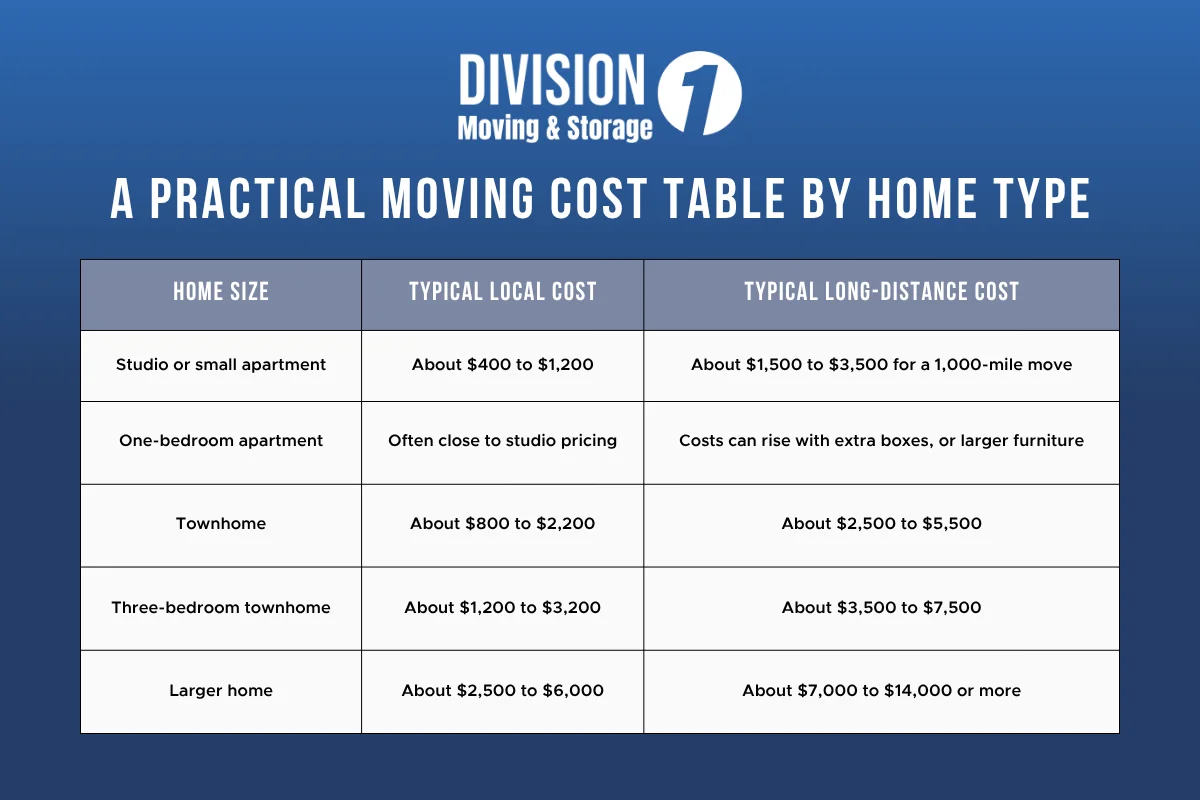
A Practical Moving Cost Table by Home Type
The most useful budget starts with a range, not a single number. A single estimate can be misleading before a mover reviews the size of the shipment, access, packing needs, and timing. Ranges help you see whether your move is likely to be simple, moderate, or complex.
Use this as a planning tool rather than a guaranteed quote. If your home has heavy furniture, multiple stairs, tight parking, or specialty items, expect your final cost to move toward the higher side. If you are flexible on dates and have easy access, your cost may stay closer to the lower side.
- Home Size Typical Local Cost Typical Long-Distance Cost Studio or small apartment About $400 to $1,200 About $1,500 to $3,500 for a 1,000-mile move One-bedroom apartment Often close to studio pricing if lightly furnished Costs can rise with extra boxes, larger furniture, or challenging access Two-bedroom apartment or townhome About $800 to $2,200 About $2,500 to $5,500 Three-bedroom townhome or single-family home About $1,200 to $3,200 About $3,500 to $7,500 Four-bedroom single-family home About $1,800 to $4,500 About $5,000 to $10,000 Five-bedroom or larger home About $2,500 to $6,000 or more About $7,000 to $14,000 or more
Labor Costs Depend on Crew Size and Total Hours
For local moves, labor is often the biggest part of the bill. Professional movers typically price local moving on an hourly basis. The hourly rate is tied to the size of the crew, the truck, and the total time needed to load, transport, and unload.
National data shows hourly rates around $108 to $125 for local movers, with lower-end rates around $80 to $90 and higher-end rates up to $180 to $250 in premium markets or complex situations. These rates often include two movers and a truck, while additional movers increase the hourly cost.
Labor cost is not only about the number of bedrooms. It is also about how easy it is to move each item. A well-packed apartment with a reserved elevator can take less time than a smaller home with narrow stairs, disassembled furniture, and no nearby parking.
Typical crew sizes by home size
Most moves are staffed according to the expected workload. A crew that is too small can make the move take longer. A crew that is properly sized can move heavier furniture more safely and may reduce total hours for larger homes.
Studios and one-bedroom homes often use two movers. Two-bedroom homes commonly need two to four movers. Three-bedroom homes often need three to four movers, while four-bedroom homes may require four to five movers.
Time estimates rise in the same way. A studio may take about three to four hours. A one-bedroom may take three to six hours. A two-bedroom may take five to eight hours, while a three-bedroom can take six to ten hours. A four-bedroom home can take eight to twelve hours, not including packing.
Division 1 Moving and Storage considers these practical details when planning local moves in Northern Virginia, including crew size, timing, access, and truck needs. A well-built plan helps the moving day stay on schedule and keeps the estimate tied to the actual work required.
Truck Size and Shipment Weight Shape the Cost of Moving House
Truck needs are closely tied to the amount of furniture and boxes being moved. For local moves, a larger shipment can mean a larger truck, a longer day, or more crew members. For long-distance moves, weight and mileage become even more important.

Home Size Estimated Shipment Weight Studio About 1,500 to 2,000 pounds One-bedroom home Roughly 2,000 to 3,000 pounds Two-bedroom home Approximately 5,000 to 6,000 pounds Three-bedroom home Often 8,000 to 10,000 pounds Four-bedroom home Around 12,000 to 15,000 pounds
These typical shipment weight estimates show why moving costs tend to increase as homes get larger. As shipment weight rises, long-distance pricing also goes up, because interstate moves usually take both weight and mileage into account.
Cross-country moving guidance shows broad overall ranges of $2,400 to $12,000, with typical two to three-bedroom homes often at $4,500 to $7,000 depending on service level and distance. That wide spread is one reason an inventory-based estimate matters.
Packing Services and Supplies Can Add Hundreds or Thousands
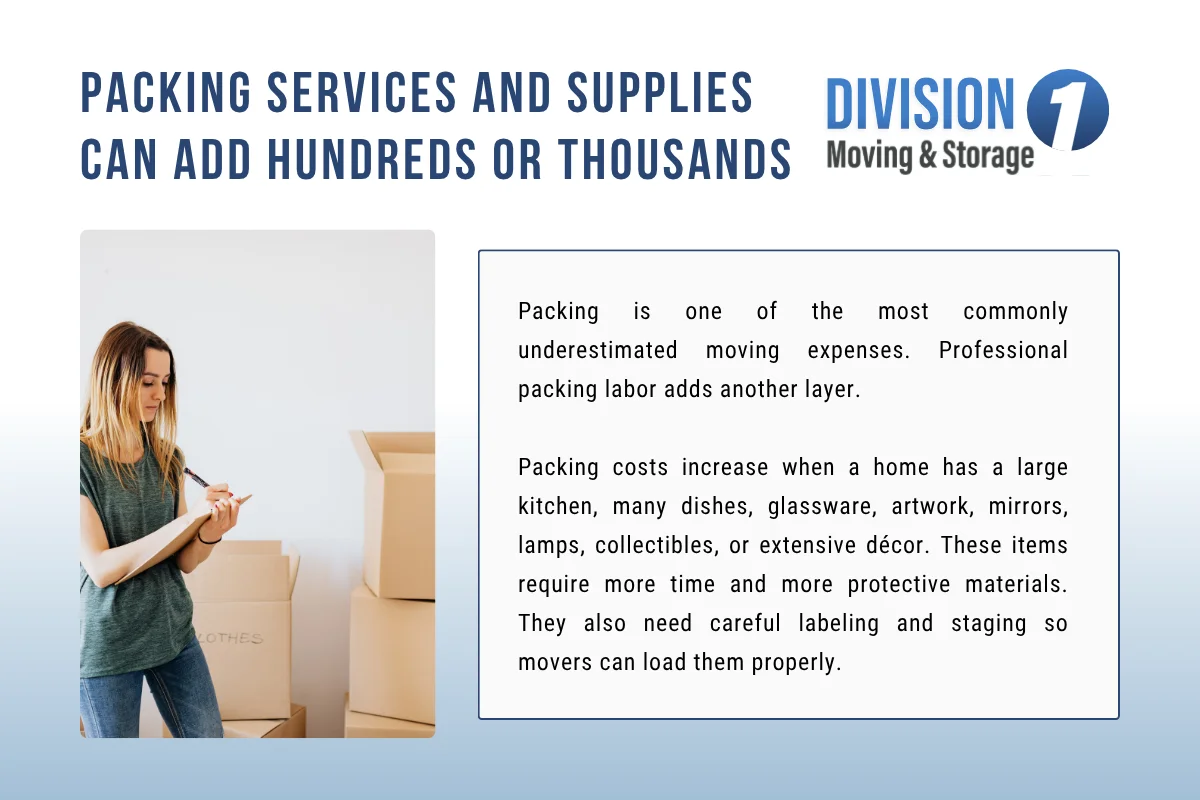
Packing is one of the most commonly underestimated moving expenses. Even if the transport estimate looks manageable, boxes, paper, tape, mattress covers, dish packs, and specialty cartons can add a separate cost. Professional packing labor adds another layer.
For a standard two to three-bedroom household, packing can commonly add $300 to $1,000 or more on top of basic moving charges. Larger homes can exceed that range because there are more rooms, more fragile items, and more materials.
Packing costs increase when a home has a large kitchen, many dishes, glassware, artwork, mirrors, lamps, collectibles, or extensive décor. These items require more time and more protective materials. They also need careful labeling and staging so movers can load them properly.
A realistic packing budget separates labor from supplies
Packing supplies are usually separate from labor. A typical home may need $100 to $400 in materials if supplies are purchased through the mover. Customers who buy their own materials should still plan for a few hundred dollars for quality boxes and protection for a two to three-bedroom home.
Some supplies cost more because they are designed for specific items. Wardrobe boxes, dish-pack boxes, specialty TV boxes, mattress covers, and heavy-duty materials can raise the total. These supplies may be worth budgeting for if they reduce damage risk or make loading more efficient.
The simplest way to control this part of the move is to decide early what you will pack yourself and what should be handled by professionals. Many customers choose partial packing for fragile rooms, artwork, glass, or kitchens, while packing clothing, books, and everyday items themselves.
Specialty Items Can Change the Final Moving Estimate
Some belongings need extra planning because they are heavy, fragile, awkward, or difficult to disassemble. Specialty items are not always covered by a basic moving estimate. If you have one, it should be listed clearly before moving day.
Hidden moving cost guides commonly identify bulky or specialty handling for items such as pianos, pool tables, safes, large armoires, and hot tubs. These pieces may require extra crew, extra equipment, careful disassembly, or a different moving approach.
Specialty item fees can commonly add $150 to $500 or more per item, depending on weight and required disassembly. Furniture disassembly and reassembly can also raise labor time or appear as a separate line item, especially for beds, sectional sofas, gym equipment, and large furniture systems.
A three-bedroom long-distance move with partial professional packing and one piano shows how quickly add-ons affect the budget. The base transport might be $3,500 to $7,500. Add $500 to $1,200 for packing and $200 to $400 for the piano, and the total can move into the $4,200 to $9,000 range.

A Moving Expenses Checklist Helps Prevent Surprise Costs
A moving expenses checklist is useful because the final cost is rarely just “movers plus truck.” The better your checklist, the less likely you are to be surprised by access fees, storage, packing materials, specialty handling, or schedule changes. It also helps you compare estimates more clearly.
Before requesting or reviewing a quote, write down the conditions at both your current home and new home. The truck route, stairs, elevators, parking, and timing can all affect the cost. A complete list gives the mover the information needed to estimate the work realistically.
Use the checklist below to organize the most common cost categories. It is not meant to replace a quote, but it can help you ask better questions and build a more accurate budget. The key is to include every item that could add labor, time, materials, or risk.
- Base moving cost: Local hourly rate or long-distance transport estimate based on home size, weight, and distance.
- Crew size: Number of movers needed for the home, stairs, heavy furniture, and expected workload.
- Estimated hours: Load time, drive time for local moves, unload time, and any waiting or building access delays.
- Truck needs: Truck size, number of trucks, shuttle needs, or special access concerns.
- Packing supplies: Boxes, tape, paper, bubble wrap, mattress covers, wardrobe boxes, dish packs, and TV boxes.
- Packing labor: Full packing, partial packing, fragile-only packing, kitchen packing, or artwork protection.
- Specialty items: Pianos, pool tables, safes, large armoires, hot tubs, gym equipment, and oversized furniture.
- Furniture services: Disassembly and reassembly for beds, sectionals, gym equipment, or complex furniture.
- Access fees: Stairs, elevators, long carries, limited parking, tight streets, or shuttle service.
- Storage: Short-term storage in transit, monthly or daily storage fees, handling, and re-delivery.
- Coverage: Basic carrier liability or upgraded valuation coverage when available.
- Timing: Peak season, weekends, rigid dates, rush bookings, or last-minute schedule changes.
Hidden Moving Costs Often Come From Access, Timing, and Storage
Many surprise charges come from conditions that are easy to overlook during early planning. A quote based only on the number of bedrooms may not capture stairs, elevators, long walks, or parking limits. These details can change both labor time and cost.
Access-related charges may include stair fees, long-carry charges, elevator coordination, shuttle service, or extra labor. A long carry applies when the truck cannot park close to the entrance. In that case, movers spend more time walking items between the home and truck.
Moving cost guidance notes that when a truck cannot park right outside, customers should expect possible extra charges for long carries, stairs, elevator use, or shuttle services. These costs can be structured as flat difficulty fees, distance-based surcharges, or added labor time.
Fuel and transportation surcharges can also appear, particularly for long-distance moves. Some estimates include fuel within the overall rate, while others show fuel as a separate line item. Tolls and transportation-related charges may also be part of the total carrier rate.
Storage is another common cost when move-out and move-in dates do not line up. Short-term storage in transit can add daily or monthly fees, handling, and re-delivery costs. For a typical household, storage and re-delivery can add hundreds of dollars, especially in urban markets.
Season, Weekday, and Flexibility Can Move Your Quote Up or Down
Timing affects moving prices because demand changes throughout the year and week. Summer months, roughly May through September, are peak moving season. During that period, prices often sit toward the upper end of the standard ranges for both local and long-distance moves.
Weekends are also high-demand periods. Saturdays are especially popular, and many cost breakdowns identify weekend moves as more likely to carry premium pricing compared with weekday moves. Monday through Thursday can sometimes offer more flexibility.
Date flexibility matters most when the moving company is trying to schedule crews, trucks, and delivery windows efficiently. Customers with strict closing dates, same-day timing requirements, or last-minute bookings may have fewer options. Customers who can accept a multi-day window may have a better chance of staying within the lower or middle part of their home-size range.
Access and timing can also overlap. A downtown apartment with limited parking on a Saturday in peak season can be harder to schedule and slower to execute. A flexible weekday move with clear access can be more straightforward, even if the home size is similar.
How to Estimate Your Own Average Cost of Moving Before Requesting a Quote
A useful moving estimate starts with the home-size range, then adjusts for real-world details. This approach helps you avoid planning around a number that is too low. It also gives you a better way to compare estimates from different providers.
Start by choosing the range that matches your home type. Then decide whether your move is likely to fall at the low, middle, or high end. Easy access, fewer belongings, DIY packing, flexible dates, and no specialty items generally push the estimate lower.
Heavy furniture, stairs, elevators, limited parking, weekend scheduling, peak season dates, professional packing, storage, and specialty items push the estimate higher. If several of those apply, build a contingency line into your budget rather than assuming the base range will cover everything.
A simple example for a two-bedroom apartment
A local two-bedroom apartment move may start with a range of $800 to $2,200. If the apartment has elevator access, close truck parking, and mostly DIY packing, the move may stay nearer the lower or middle part of that range.
If the same apartment has a long hallway, limited loading access, many fragile items, and partial packing services, the estimate can move higher. Add specialty furniture or storage, and the total can exceed the base expectation.
A simple example for a three-bedroom townhome
A local three-bedroom townhome may start around $1,200 to $3,200. Stairs are common in townhomes, so labor time may be higher than a flat single-level home with the same number of bedrooms.
For long-distance, the base range may be about $3,500 to $7,500. If the home includes partial packing, one piano, or a large amount of furniture, the final number can move into a higher total range after add-ons.
A simple example for a four-bedroom single-family home
A four-bedroom local move often starts around $1,800 to $4,500. The final cost depends on how much is in the garage, basement, attic, outdoor areas, and storage spaces. These areas often add more boxes and weight than expected.
For long-distance, a four-bedroom home may cost about $5,000 to $10,000. If the shipment is closer to the high end of typical weight estimates, or if the move requires multiple trucks, storage, packing, or specialty handling, the total can rise beyond the base range.
Get a Quote for a Move in Northern Virginia
The average cost of moving is most useful when it helps you ask the right questions: how many movers, how many hours, what truck size, what packing, what specialty items, and what access issues. Once those details are clear, your estimate becomes much more practical.
If you are planning a local move, long-distance move, packing help, storage, or specialty moving support from Northern Virginia, Division 1 Moving and Storage can help you price the work clearly. Get a Quote by calling (571) 970-3189 or visiting https://www.division1moving.com/contact-us.