


.svg)
Changing schools mid year is rarely just a school decision. For families who are also packing a home, coordinating records, and helping children adjust emotionally, the school transition needs to be planned alongside the move itself.
The biggest mistake parents can make is treating school enrollment as something to handle after moving day. A smoother transition usually starts earlier, with direct communication, organized documents, a realistic calendar, and familiar routines that help children feel steady while everything around them changes.
At Division 1 Moving and Storage, we help homeowners and renters across Alexandria and Northern Virginia plan moves around real family schedules, including school calendars, enrollment appointments, and the first week in a new classroom. If you have questions while planning a move during the school year, you can reach us at (571) 970-3189.
Changing schools during the school year starts with the academic calendar
Parents often begin with the move date, then try to make school fit around it. When children are involved, it is better to reverse that order. The academic calendar should be part of the moving plan before the truck is booked.
Families should look closely at report cards, benchmark tests, state testing windows, final exams, parent-teacher conferences, field trips, sports commitments, and club schedules. A move that seems convenient for adults may land at a hard point in the school year for a child.
ASU Prep Digital advises families to review the academic calendar and upcoming milestones before a mid-year transfer, and warns that moving right before final exams or standardized testing can add pressure to an already difficult change. Its suggested transition planning timeline includes 1-2 weeks for school research, 1-2 weeks for paperwork and enrollment, and about another week for transition planning.
That timeline matters. Even when a move is urgent, school research, document gathering, and teacher communication take time. If parents can create even a small planning window before moving day, they can reduce the chance that a child arrives at a new school tired, unprepared, or missing key paperwork.
Move dates should avoid the hardest school moments when possible
Not every family has control over timing. Leases end, home closings shift, jobs start, and long-distance moves can create fixed deadlines. Still, when there is flexibility, parents should avoid scheduling the most disruptive parts of the move right before major academic events.
For example, loading the truck late the night before a child’s first day at a new school can make the transition harder. So can arriving in a new home with no time to find school supplies, confirm transportation, or review the morning routine.
A better target is to create a buffer between move-in and the first day of school. Even one to three days can help children sleep, unpack basic items, visit the school if possible, and understand what the new morning will look like.
Enrollment and school records should be gathered before moving day
School enrollment often depends on documents that are easy to misplace during a move. Birth certificates, proof of residency, immunization records, health forms, transcripts, report cards, and special education documents should be separated from general packing before boxes are sealed.
Parents should keep a personal copy of every important school document. Records may transfer between schools, but families should not rely only on that process. A clearly labeled folder can prevent delays if the new school needs a form immediately.
The core paperwork for changing schools during school year is generally consistent across districts. Families should expect to gather proof of residency, a birth certificate or government-issued ID, immunization and health records, prior transcripts or report cards, and special education records when applicable.
A school transfer folder keeps enrollment from getting buried in moving boxes
A physical or digital folder should stay with the parent, not in the moving truck. This is especially important during a long-distance move or a move with storage, where household goods may not be immediately accessible.
Before the move, parents should contact the current school and ask what is needed for withdrawal. They should also contact the new school or district and confirm enrollment rules, zoning, forms, and deadlines. Public School Review recommends contacting the new district before the move to confirm zoning rules and enrollment deadlines.
A school transfer folder may include:
Proof of residency for the new address
Birth certificate or government-issued ID
Immunization and health records
Recent report cards and transcripts
Current class schedule, if applicable
Withdrawal or transfer forms from the previous school
IEP or 504 plan documents, if applicable
Contact information for the current and new school
Transportation, lunch, and school start-time details
This folder should be treated like medication, keys, and identification during a move. It belongs in the car or with the parent throughout the transition.
Early communication with both schools reduces avoidable stress
Communication is one of the most important parts of changing schools mid year. Parents need information from the current school, the new school, teachers, counselors, and administrators. Waiting until the last minute can create confusion around records, placement, transportation, and classroom expectations.
The current school can help with withdrawal steps, progress notes, and record transfer. The new school can explain enrollment requirements, daily routines, teacher expectations, and available extracurricular options. These conversations give parents the details they need to prepare the child for the first day.
Moving Help recommends notifying the current school as soon as possible that the family is looking for a new school, so teachers and principals can help guide the withdrawal process and support correct records transfer. It also advises parents to introduce themselves to teachers, counselors, and administrators once the family is unpacked and school is about to begin.
Teachers can help explain what a child needs academically and socially
A child’s current teacher may be able to provide useful notes about academic progress, learning style, classroom strengths, and social needs. That information can help the new teacher understand the child more quickly.
Parents can ask the current teacher whether there are skills being practiced, assignments in progress, or areas where the child may need extra support during the transition. This is not about creating a perfect handoff. It is about giving the next school enough context to avoid starting from zero.
Parents should also ask the new school practical questions. What time should the child arrive? Where do students go first? How does lunch work? Are there classroom rules or routines the child should know? Are clubs, sports, or after-school programs available?
Students with IEPs or 504 plans need extra records follow-up
For children with disabilities, changing schools during school year can affect services as well as enrollment. Parents should make sure special education records are included in the transfer packet and should keep complete copies for their own files.
The Learning Disabilities Association of America stresses that parents should obtain complete copies of school records and confirm that IEP and related service records are included. Under IDEA, a child who transfers within the same academic year must receive services comparable to the previous IEP until the new district adopts the old IEP or creates a new one.
Parents should follow up if records have not arrived within two weeks. Delayed records can disrupt required services, so this is one area where persistence matters.
The first week at the new school should be planned like a launch
The first week after a school move can feel crowded. Children are learning a new building, new classmates, new teachers, new routines, and sometimes a new academic pace. Parents are often still unpacking, setting up utilities, and finding everyday household items.
A first-week plan helps protect the child from unnecessary chaos. It does not need to be complicated. The goal is to make the basics predictable, especially the morning routine, transportation, meals, school supplies, and paperwork.
Before the first day, parents should know what time school starts, how drop-off or bus transportation works, what the child needs for lunch, and who to contact with questions. They should also keep the school transfer folder accessible in case the office needs a missing form.
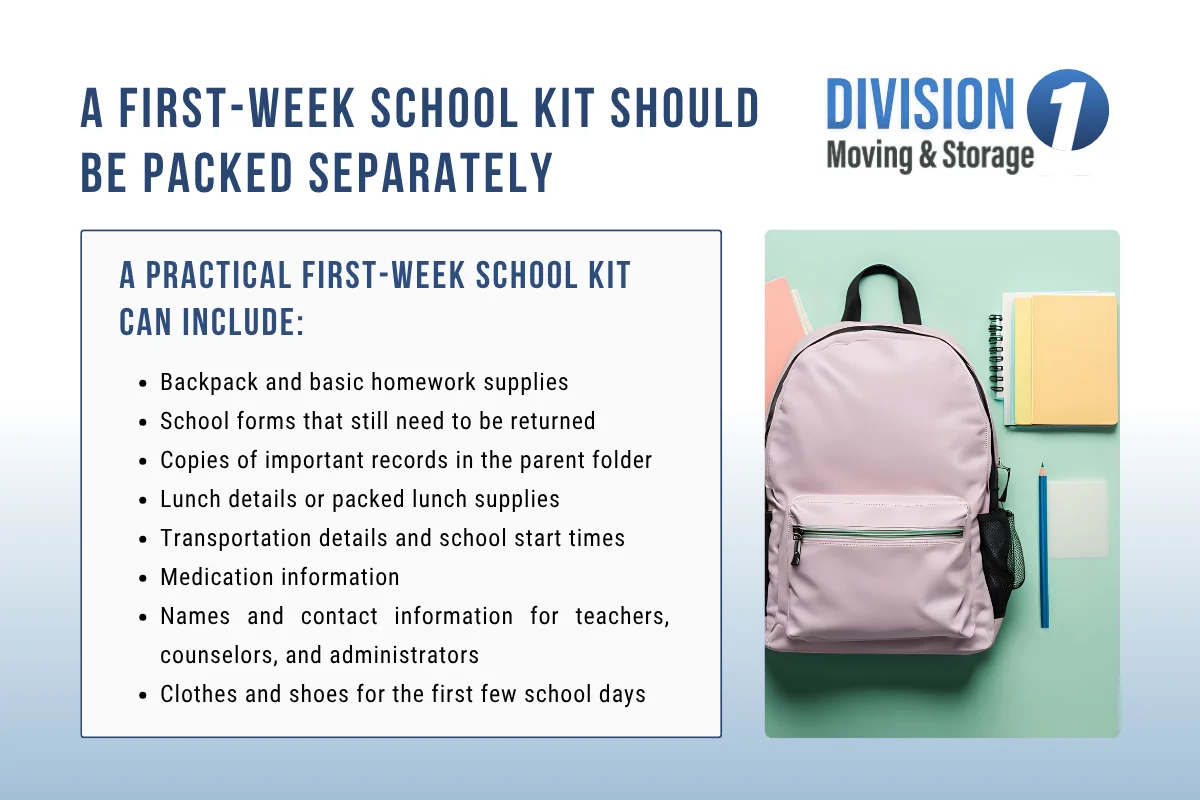
A first-week school kit should be packed separately from household boxes
Moving boxes are not always unpacked in the order families expect. School items should be packed separately so the child is not searching through kitchen, bedroom, or storage boxes the night before the first day.
This kit should include what the child needs immediately, not everything that belongs in the classroom long term. The key is to avoid first-morning stress caused by a missing backpack, paper, contact form, or lunch detail.
A practical first-week school kit can include:
Backpack and basic homework supplies
School forms that still need to be returned
Copies of important records in the parent folder
Lunch details, lunch account information, or packed lunch supplies
Transportation details and school start times
Medication information, if permitted by district policy
Names and contact information for teachers, counselors, and administrators
Clothes and shoes for the first few school days
Families using packing help should identify school essentials before packing begins. At Division 1 Moving and Storage, this is the kind of planning detail we encourage families to think through early, because accessible school items can make the difference between a rushed first day and a calmer one.
Routines at home help children feel stable after a school move
Moving during school year can disrupt almost every part of a child’s daily life. The home changes. The school changes. Friends change. Routes, classrooms, expectations, and activities may all feel unfamiliar.
Because so much is new, familiar routines become important. Parents do not need to preserve every habit from the previous home, but keeping a few predictable anchors can help children feel more secure.
Moving Help recommends keeping familiar habits such as family dinners, game nights, and after-school snacks because regular routines help children feel more at home. ASU Prep Digital also says that maintaining routines from the previous school, such as morning rituals or snack time, can provide stability.
Simple daily anchors can make the new home feel less unfamiliar
Parents can focus on the routines children experience most often. Bedtime, wake-up time, breakfast, homework time, dinner, and a short evening check-in are good places to start.
If the family always had an after-school snack before homework, keep that pattern. If the child is used to packing a backpack the night before, continue that habit. If family dinners were part of the old routine, protect them during the first weeks after the move when possible.
The purpose is not to pretend nothing has changed. The purpose is to give children proof that some parts of life are still familiar and dependable.
Emotional adjustment is part of the school transfer, not a separate issue
A school move can be emotionally disruptive. Children may feel sad about leaving friends, nervous about meeting new classmates, frustrated by different routines, or lonely during the first weeks. These reactions do not mean the move is going badly. They mean the child is adjusting.
UNIS Hanoi explains that moving schools can trigger anxiety, sadness, frustration, and loneliness, and may create confusion as children adjust to new routines and teaching styles. Public School Review also notes that students may struggle with new academic standards, unfamiliar school cultures, and rebuilding friendships.
Parents can help by keeping communication open at home. A child may not be ready to share everything on the first day, but regular low-pressure check-ins make it easier for them to talk when they are ready.
Small social steps are often more realistic than instant friendships
Parents naturally want children to make friends quickly. In many cases, that takes time. New students may be entering established peer groups, classroom routines, clubs, and social circles that already have their own rhythm.
ASU Prep Digital recommends practicing self-introductions and role-playing classroom or group scenarios so children feel more confident on the first day. It also suggests encouraging children to participate in classroom discussion, team activities, clubs, and after-school programs because those settings create repeated contact with peers.
Parents can also support friendships outside school. UNIS Hanoi suggests introducing children to other kids in the community and arranging playdates. ASU Prep Digital also recommends reaching out to other parents and volunteering at school events when possible.
Small wins matter. A child saying hello to one classmate, finding someone to sit with at lunch, joining a club, or learning the route to class can all be signs of progress.
High school students may need extra planning around credits and graduation
Changing schools mid year can be more complicated for high school students because credits, graduation requirements, exams, and semester timing may be involved. Parents should speak with the new school early to understand how prior coursework will transfer.
Public School Review says high school families should confirm that transferred credits align with graduation requirements in the new district. Maryland’s People’s Law Library notes that students transferring during the school year can generally retain credit for work done during the semester.
When a transfer happens near the end of a term, principals may decide whether the student takes exams at the old school, the new school, or receives credit based on prior work. Parents should ask about this directly instead of assuming the answer will be automatic.
Counselor communication is especially important for older students
High school students may be more independent, but they still need adult help during a mid-year transfer. A guidance counselor can help review credits, course placement, graduation requirements, and scheduling concerns.
Maryland’s People’s Law Library advises parents to contact the child’s guidance counselor at the old school, explain the last day, request the transfer form, and then set up an appointment at the new school. This sequence helps both schools understand the timing and reduces the risk of missing steps.
Parents should encourage older students to ask questions too. They may want to know about clubs, sports, class levels, lunch schedules, and graduation requirements. Including them in the process can help them feel less like the move is simply happening to them.
Long-distance moves require earlier school coordination
Long-distance moves make school planning more important because families have less flexibility once the move is underway. If documents are missing, enrollment rules are unclear, or the delivery schedule leaves no adjustment time, the first school week can become harder than necessary.
Every district can have different transfer procedures, deadlines, eligibility rules, and transportation arrangements. Parents should start researching schools in the new area as soon as they know they are moving.
For long-distance moves, the moving calendar and school calendar should be built together. Families may need time for enrollment appointments, school tours, teacher meetings, and a quiet settling-in period before classes begin.
Packing and delivery priorities should support the school transition
When a child is changing schools during school year, not every box has the same urgency. School supplies, clothing, records, lunch items, technology used for homework, and bedroom basics should be easier to access than seasonal items or décor.
Parents can label school-related boxes clearly and keep the most important items outside the general moving load. If storage is part of the move, they should be careful not to place essential school records or first-week items into storage by mistake.
Staged unpacking can also help. Bedrooms, school supplies, and kitchen basics often matter more in the first few days than fully arranging every room. A functional sleep routine, breakfast routine, and homework space can support the school transition even while the rest of the home is still coming together.
A parent checklist for moving during school year
A checklist can help parents see the school transition and move as one connected plan. The details may vary by district and child, but the main categories stay consistent: timing, records, communication, routines, and emotional support.
This checklist is most useful when started before moving day. Some steps, such as requesting records or confirming enrollment rules, can take longer than expected. Others, like preserving bedtime routines, are simple but easy to overlook during a busy move.
Parents can use the following list as a practical planning tool:
Review the academic calendar before finalizing the move date.
Avoid major testing periods, final exams, or term-end deadlines when possible.
Contact the new district to confirm zoning, enrollment rules, and deadlines.
Notify the current school as early as possible.
Request withdrawal forms, transfer forms, and school records.
Keep personal copies of report cards, transcripts, health records, and identification.
Include IEP or 504 documents in the transfer folder if applicable.
Confirm whether records have arrived at the new school.
Schedule a meeting or conversation with the new teacher or counselor.
Ask about classroom routines, transportation, lunch, and arrival procedures.
Pack a first-week school kit separately from household boxes.
Create a buffer between move-in and the first school day when possible.
Keep bedtime, meals, homework time, and family check-ins predictable.
Encourage clubs, sports, classroom participation, or other repeated social contact.
Celebrate small signs of adjustment, not just major milestones.
No checklist can remove every challenge from changing schools mid year. But planning gives parents more control over the parts they can influence, and that can make the transition feel less sudden for the child.
A school-year move works best when the home and classroom plans support each other
Families often think of a move as one project and a school transfer as another. In reality, they overlap. The timing of packing, loading, delivery, unpacking, enrollment, and the first day of school all affect each other.
The best plan gives children time to arrive rested, prepared, and familiar with the basics. It keeps records accessible. It gives teachers and counselors enough information to help. It preserves routines at home while the child adjusts to a new classroom and new classmates.
Changing schools mid year is not always ideal, but it can be handled thoughtfully. Parents who communicate early, protect familiar routines, and plan the moving schedule around school priorities give their children a stronger start in the new environment.
If your family is moving during the school year in Alexandria or Northern Virginia, Division 1 Moving and Storage can help you plan a move that supports your school timeline, packing needs, and first-week priorities. Get a Quote by calling (571) 970-3189 or visiting https://www.division1moving.com/contact-us.