


.svg)
Alexandria neighborhoods can feel close together on a map, but they offer very different day-to-day lifestyles. A move to Old Town may mean historic rowhouses, waterfront walks, and tight curb access. A move to Del Ray may center on a neighborhood main street and a mix of homes, townhouses, condos, and apartments. A move to the West End may prioritize space, value, and easier driving logistics.
This Alexandria neighborhoods guide is designed for people comparing where to live, how to commute, and what kind of home will best fit their next move. We will focus on Old Town, Del Ray, the West End, and other family-friendly considerations, with practical notes on housing types, commute patterns, parking, and move-day planning.
At Division 1 Moving and Storage, we help homeowners, renters, and families move throughout Alexandria and Northern Virginia, so we see how neighborhood layout affects the moving experience. If you have questions while planning a move, you can reach us at (571) 970-3189.
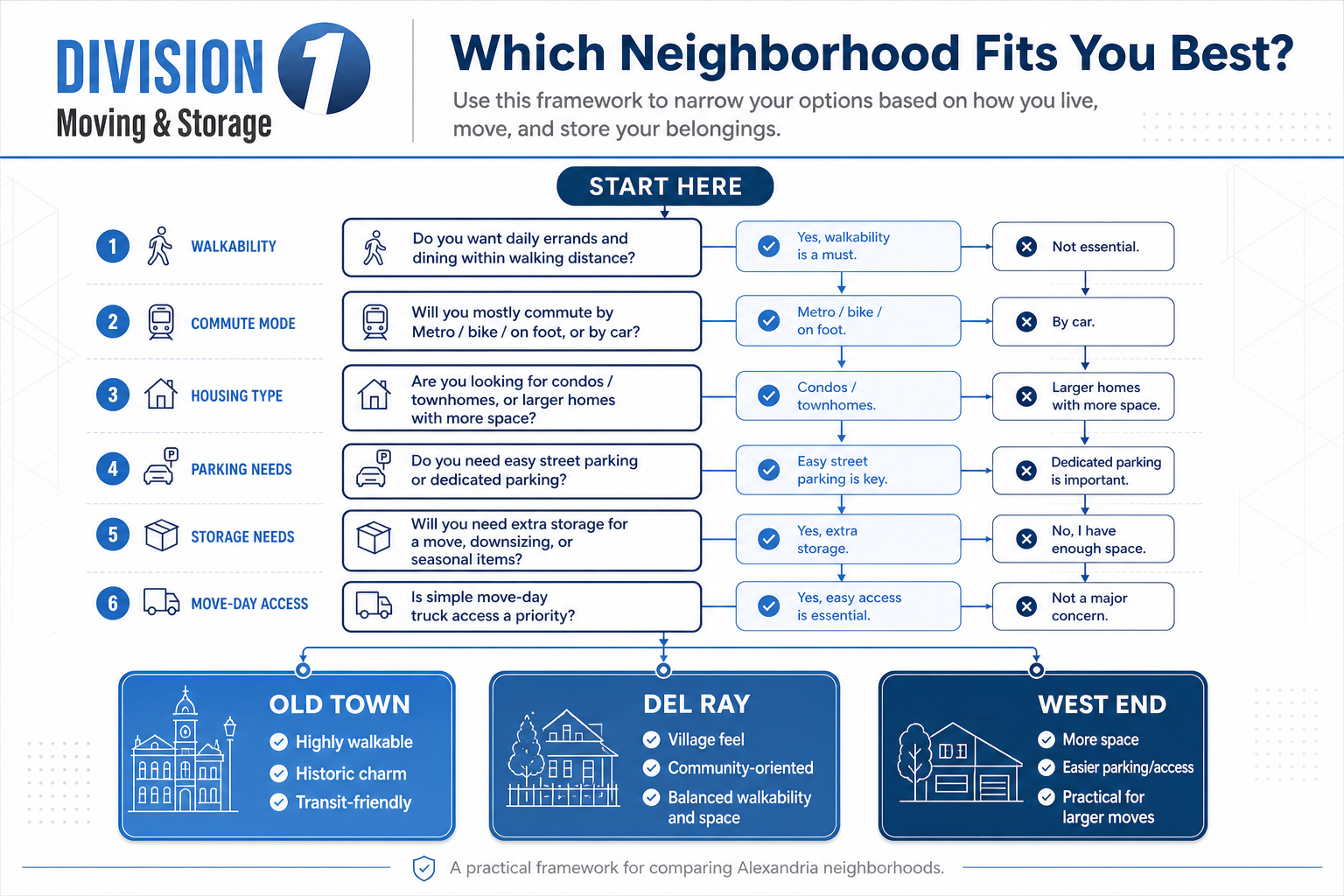
Alexandria neighborhoods vary most by walkability, housing type, and commute style
Choosing among Alexandria neighborhoods is not only about finding a place with the right rent or sale price. It is also about matching your daily routine to the street pattern, parking situation, commute options, and housing style. Two homes with similar square footage can create very different moving and living experiences depending on the neighborhood.
Old Town, Del Ray, and the West End are three useful starting points because they represent distinct versions of Alexandria living. Old Town is the historic, waterfront, highly walkable option. Del Ray is more neighborhood-scale and community-oriented, centered on Mount Vernon Avenue. The West End is larger, more suburban in feel, and often more practical for space, storage, and car access.
Cost also changes by neighborhood and housing type. Alexandria is a high-cost market by Virginia standards, especially close to the waterfront and Metro stations. One recent neighborhood guide cites citywide figures including a median owner-occupied housing value of $735,100, median gross rent of $2,089, median monthly owner cost with a mortgage of $3,237, and an average commute time of 28.4 minutes.
Old Town is best for historic character, waterfront access, and car-light living
Old Town is Alexandria’s signature neighborhood. Founded in 1749, it is known for cobblestone streets, red-brick sidewalks, historic architecture, boutiques, restaurants, waterfront parks, and frequent events along the Potomac River. For many people searching for the best neighborhoods in Alexandria, Old Town is the first place they picture.
The lifestyle appeal is clear. Residents can live near the waterfront, walk to restaurants and shops, and enjoy one of the city’s most recognizable historic districts. For people who want a high-amenity setting and do not want every errand to require a car, Old Town is one of Alexandria’s strongest matches.
Old Town housing often means historic townhouses, condos, and dense blocks
Old Town’s housing is dominated by historic townhouses and townhouse-like properties, though the broader city housing mix also includes condos, apartments, and some detached homes. This variety gives renters and buyers multiple ways to enter the neighborhood, but many properties are older and denser than suburban-style housing.
That density matters during a move. Old Town homes may have tighter entryways, older staircases, smaller curb zones, and fewer driveway options. Apartments and condos may require elevator scheduling or building approvals. Rowhouses can involve longer carries from the truck if street parking is limited.
Old Town is also one of Alexandria’s more expensive housing markets. Recent neighborhood rental estimates place Old Town around $3,000 to $3,572 for median or typical monthly rent, depending on the source and definition. Ownership costs are also high, with current snapshots showing Old Town rowhouse-style homes well above $1 million in some cases.
Old Town commute options support Metro, trolley, VRE, and Amtrak access
Old Town has strong transit access compared with more car-oriented parts of Alexandria. The neighborhood is served by King Street-Old Town and Braddock Road stations on the Blue and Yellow lines. Alexandria Station at 110 Callahan Drive serves VRE’s Fredericksburg and Manassas lines, and Alexandria Union Station is next to King Street Metro and also serves Amtrak.
The King Street corridor is a major advantage for residents who want a car-light commute. The free King Street Trolley runs between King Street Metro and City Hall or Market Square every 15 minutes, seven days a week from 11 a.m. to 11 p.m. That can help connect the Metro area to the waterfront without requiring a daily drive.
Del Ray is a strong choice for main-street living, community feel, and varied housing
Del Ray offers a different version of Alexandria life. Centered on Mount Vernon Avenue, it is known for a walkable main-street feel, murals, local shops, outdoor gathering spots, and recurring community events. Compared with Old Town, Del Ray feels more neighborhood-scale while still offering access to transit, dining, and everyday amenities.
This makes Del Ray especially appealing to young professionals, renters, first-time buyers, and families who want a balance of local character and practical housing options. It is often discussed among the best neighborhoods in Alexandria because it provides walkability without feeling as dense or tourist-oriented as Old Town.
Del Ray’s mix of homes, townhouses, condos, and apartments creates a flexible housing ladder
Del Ray’s housing stock includes single-family homes, condominiums, townhouses, and apartments. That mix is one of the neighborhood’s main strengths. A renter may start in an apartment, a first-time buyer may look at a condo or townhouse, and a family may search for a single-family home within reach of parks and schools.
Pricing is generally lower than Old Town, but still high compared with many suburban Alexandria options. Recent rent data places Del Ray below Old Town, with one source showing median rent around $2,447 and others showing averages closer to $2,326 to $2,554. Home prices remain competitive, with current snapshots showing median sale prices ranging from the high $700,000s to around $900,000.
From a moving standpoint, Del Ray is usually more manageable than Old Town, but it is not always simple. Residential streets can still be narrow, some blocks may have parking controls, and the variety of housing types means every move has different access needs. A single-family home, a townhouse, and a small multifamily building can each require a different plan.
Del Ray commute patterns depend heavily on the exact block
Del Ray has strong commute potential, but the experience varies by location. Some blocks are roughly a half-mile to one-mile walk from Braddock Metro, depending on the exact address. DASH, Metrobus, and bikeshare access also help connect residents to nearby transit options.
For many residents, Del Ray works best when the home location fits the commute routine. A household that walks to Metro may value one part of the neighborhood more than another. A household that drives may weigh street parking, driveway access, and routes out of the neighborhood more heavily.
The West End offers more space, relative affordability, and easier car-oriented logistics
The West End is Alexandria’s largest neighborhood area and includes communities such as Seminary Hill, Cameron Station, Taylor Run, Landmark, and other west-side subareas. It is generally more suburban in feel than Old Town or Del Ray. Larger road networks, shopping centers, parks, and recreation access play a bigger role in everyday life.
For many movers, the West End offers one of the most practical combinations in Alexandria: more space, more housing variety, and easier loading conditions. It is often a strong fit for families, downsizers, and residents who need storage, parking, or a more car-oriented routine.
West End housing often gives renters and buyers more options for the budget
The West End often provides more affordable apartment, townhome, and single-family options relative to Alexandria’s historic core. One housing-cost guide notes that renters seeking better deals often look to the West End and Arlandria, and that West End one-bedrooms can be found around the $1,500 range in some market conditions.
Another cost overview lists West End average two-bedroom rent around $1,600 and average three-bedroom home price around $450,000, though those figures vary by subarea and housing type. The important takeaway is not that every West End home is inexpensive. It is that the neighborhood area generally gives residents more ways to balance budget, space, and convenience than the most premium waterfront and historic districts.
For move planning, the West End can also be less restrictive. Driveways, garages, wider roads, and larger apartment communities may make loading and unloading simpler than in denser parts of Alexandria. Elevator access and building rules can still be major issues, especially in newer multifamily buildings and condo towers.
West End commuting is often more car-oriented, with bus-to-Metro options in some pockets
The West End leans more car-oriented than Old Town and Del Ray. Access to I-395 and larger road networks can make driving or park-and-ride commuting more efficient in some subareas. Other pockets may rely more heavily on bus connections to Metro.
This does not make the West End less desirable. It simply means commute planning should start with your actual destination and your preferred travel mode. A household that values parking, space, and road access may find the West End more practical than a denser, more walkable neighborhood.
Family-friendly Alexandria neighborhoods depend on parks, schools, space, and parking tradeoffs
Families comparing Alexandria neighborhoods often look beyond the most famous names. School proximity, access to parks, housing size, parking, and daily errands can matter as much as nightlife or waterfront access. The right fit depends on which tradeoffs matter most.
The West End gets frequent mention for families because of larger green spaces, community centers, shopping, and access to parks such as Ben Brenman Park and All Veterans Park. Del Ray also ranks well for family appeal because it combines a walkable commercial strip with local parks, community events, and a broad housing mix.
Old Town can still work for families, especially those who value walkability and the waterfront. The tradeoff is usually less space and higher cost than in many West End or outer-Alexandria options. Family-friendly Alexandria is not one single neighborhood. It is a set of choices among walkability, yard space, school proximity, parking convenience, and housing budget.
Before choosing a neighborhood, families should compare how the home, school routine, commute, and move logistics fit together. A larger home may be less useful if the commute becomes difficult. A walkable location may be less practical if parking or storage is a daily problem. The strongest choice is the one that supports the household’s regular week, not just move-in day.
Choose Old Town if walkability, waterfront access, and historic character matter more than space and easy truck access.
Choose Del Ray if you want main-street living, a community feel, and a mix of apartments, townhomes, condos, and houses.
Choose the West End if you prioritize space, relative affordability, parking, and easier car-oriented routines.
Compare school-adjacent options by exact address, since nearby schools and daily routes vary by location.
Think about storage early if your new home has less closet, garage, basement, or driveway space than your current one.
Renting versus buying in Alexandria depends on neighborhood and housing type
Rent-versus-buy decisions in Alexandria are closely tied to neighborhood. A condo in one area, a townhouse in another, and a single-family home in a third can sit in very different cost categories. That is why broad citywide averages only tell part of the story.
Across Alexandria, current market snapshots show a wide spread among property types. Condos and apartments are common entry points for renters and first-time buyers. Townhouses and rowhouses often come with higher ownership costs. Single-family homes can require larger move-in budgets and more planning for furniture, storage, and maintenance needs.
Rental prices also vary widely across the city. Premium waterfront and transit-adjacent areas like Old Town North and Potomac Yard tend to sit higher on the cost curve, while lower-cost pockets can be found in areas such as Alexandria West and Arlandria. According to one rental snapshot, Alexandria’s rental market includes average rent data that changes by bedroom count, neighborhood, and property type through rental market trends.
For movers, the rent-versus-buy decision also affects move size. A renter moving into a one-bedroom apartment may need elevator coordination and a smaller truck plan. A buyer moving into a townhouse may need stair planning and careful furniture measurements. A family moving into a detached home may need more packing time, staging, or storage between closing dates.
Commute patterns should shape your Alexandria neighborhood search from the beginning
Alexandria has multiple transportation layers, including Metrorail, DASH buses, VRE, Amtrak, Capital Bikeshare, and major highway access. That range gives residents options, but the usefulness of each option changes by neighborhood and exact address.
Old Town is strong for residents who want access to King Street-Old Town, Braddock Road, VRE, Amtrak, and the King Street Trolley. Del Ray can work well for Metro, bus, and bikeshare users, but the distance to stations changes by block. The West End often works best for residents who prioritize driving access, larger roads, and bus connections to Metro in selected areas.
Transit disruptions and route planning can also affect the moving period itself, not just the commute after move-in. Regional transportation guidance during service changes has highlighted options such as Metro alternatives, buses, and other ways to move around during a Blue and Yellow Line shutdown. That kind of planning mindset is useful whenever your move depends on timing, access, or a tight schedule.
When comparing homes, map the commute at the times you will actually travel. Also think about how you will handle the first week after the move. If your car is packed, your parking permit is pending, or your building has limited move windows, a transit-friendly location can make the transition easier.
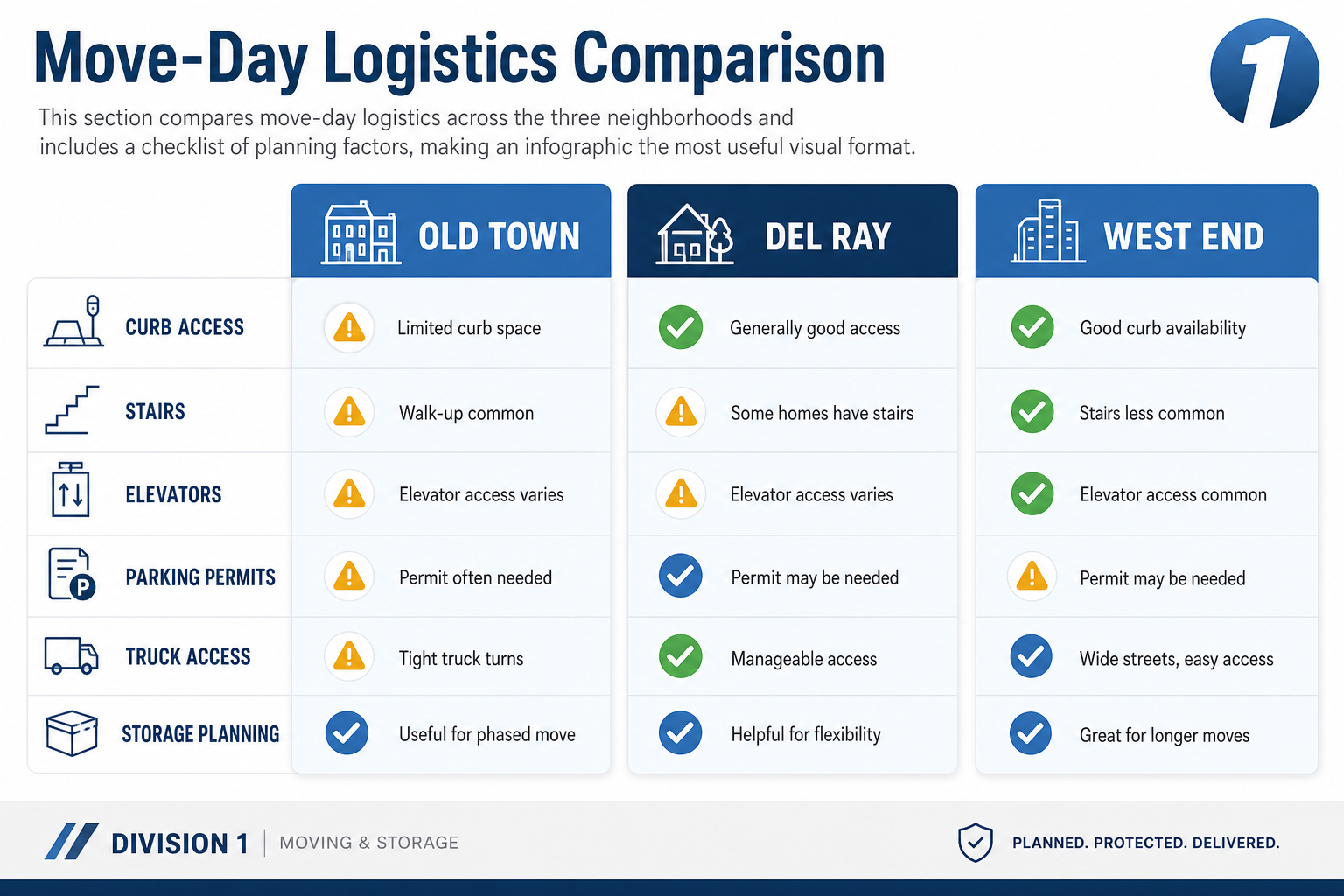
Moving logistics can change significantly from Old Town to Del Ray to the West End
Move-day planning in Alexandria should be neighborhood-specific. The same crew, truck, and furniture list can require a different strategy depending on the block. Historic streets, apartment elevators, parking restrictions, and driveway access all affect time and cost.
Old Town is often the most logistically challenging. Its historic street pattern, dense housing, tourist traffic, and parking restrictions can make curb access difficult. Del Ray is usually more manageable, but narrower residential streets and permit-controlled blocks can still create access issues. The West End often has easier truck access, but larger apartment communities and condo buildings may require elevator reservations and building approvals.
This is where planning ahead makes the biggest difference. Division 1 Moving and Storage regularly helps customers account for these Alexandria-specific details, including loading access, building requirements, packing needs, and short or long term storage when dates do not line up.
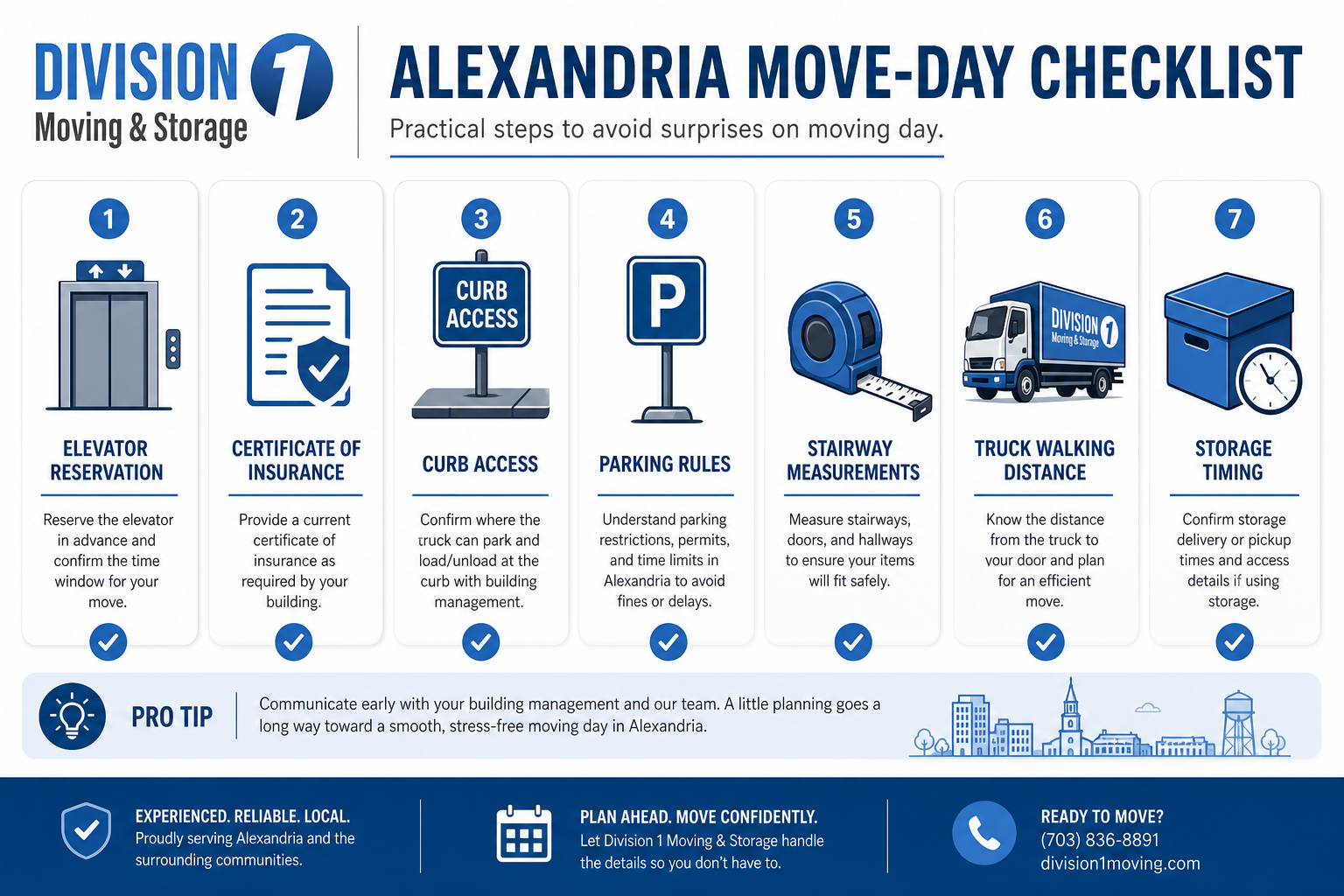
Before move day, confirm the rules that apply to your exact home or building. Do not assume that a street with open parking during a showing will be open on moving day. Do not assume that a passenger elevator can be used for furniture. Many moving delays begin with small access details that could have been checked earlier.
Ask whether the building requires a certificate of insurance before movers arrive.
Reserve elevators and confirm approved move windows for apartments and condos.
Check whether curb reservations, residential parking rules, or loading restrictions apply.
Measure stairways, doorways, and tight turns for large furniture, especially in older homes.
Plan for extra walking distance if the truck cannot park directly in front of the home.
Use storage if lease dates, closing dates, renovation work, or downsizing timelines do not align.
How to choose among the best neighborhoods in Alexandria for your next move
The best neighborhoods in Alexandria are not ranked the same way for every household. A renter who wants nightlife and Metro access may choose differently than a family seeking space and parks. A downsizer may care more about elevator access and storage than yard size. A commuter may prioritize transit, while another household may need reliable parking and highway access.
Start by narrowing the choice to lifestyle. Old Town is ideal for historic character, walkability, waterfront access, and a car-light routine. Del Ray is a strong fit for people who want main-street living, community events, and varied housing. The West End is practical for space, value, driving access, and larger-home logistics.
Then evaluate the home itself. In Alexandria, a neighborhood name does not tell you everything. The exact block, building rules, parking situation, and home layout can matter as much as the ZIP code. A great location can become stressful if the move-in process is not planned around access.
A simple neighborhood decision framework can prevent move-day surprises
Use the neighborhood search to answer both lifestyle and logistics questions. This will help you compare homes more realistically and avoid focusing only on rent, sale price, or square footage. The most useful Alexandria neighborhoods guide is one that connects where you want to live with how you will actually move in and settle there.
Think through a normal weekday, a grocery run, a commute, and the physical move. If those all work, the neighborhood is more likely to fit. If one of them creates a serious obstacle, decide whether the tradeoff is worth it before signing a lease or closing on a home.
As you compare your options, keep the following questions close:
Do you want to walk most places, or do you prefer easier parking and driving access?
Is your commute tied to Metro, VRE, Amtrak, DASH, a bike route, or I-395 access?
Will your furniture fit through older rowhouse entries, staircases, and tight turns?
Does the building require elevator reservations, a certificate of insurance, or specific move windows?
Would temporary storage help if your lease, closing, or renovation schedule changes?
Are you choosing a home that fits your daily routine after the moving truck leaves?
Plan your Alexandria move around the neighborhood, not just the address
Alexandria rewards careful neighborhood choice. Old Town, Del Ray, and the West End each offer a different balance of walkability, housing type, commute access, cost, and move-day logistics. Other family-friendly areas add even more variation, especially when parks, school proximity, storage, and parking are part of the decision.
If you are moving within Alexandria or relocating to Northern Virginia, plan early around the details that make each neighborhood unique. For help with local moving, long distance moving, packing, storage, furniture assembly, move-out cleaning, repairs, or junk removal, contact Division 1 Moving and Storage. Get a Quote at https://www.division1moving.com/contact-us or call (571) 970-3189.